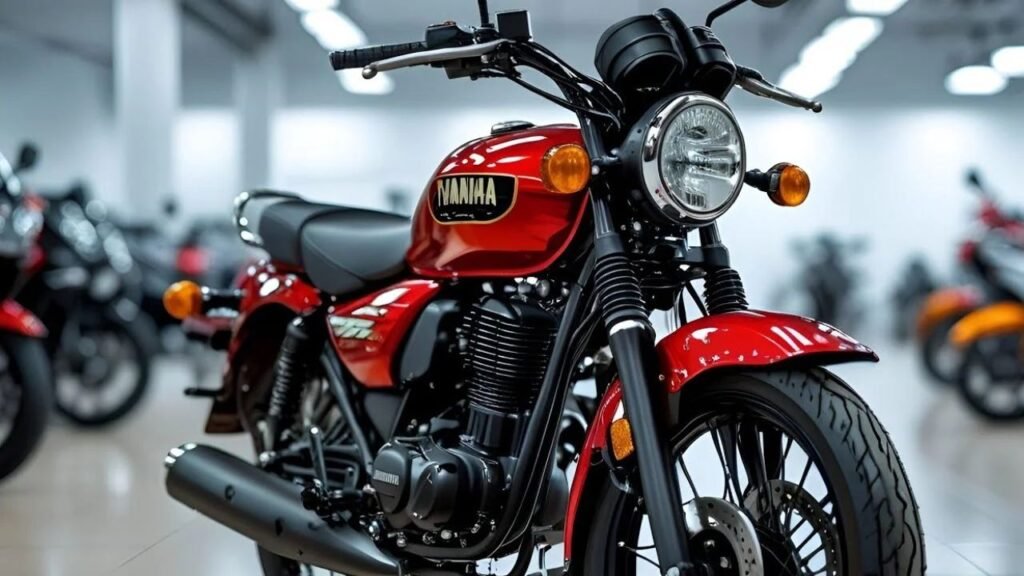
There are motorcycles that sell well, and there are motorcycles that become legends. The difference between the two has nothing to do with production numbers, sales figures, or feature lists. It has everything to do with how deeply a machine embeds itself into the emotional memory of a generation — how completely it captures a particular feeling, a particular era, a particular version of freedom that cannot be replicated or replaced once it is gone. By this measure, the Yamaha RX100 is not merely a legend. It is perhaps the purest and most enduring legend that Indian motorcycling has ever produced, and decades after its discontinuation, it continues to inspire a reverence and passionate loyalty that the most advanced and expensive modern motorcycles can only envy from a distance.

Ask any Indian man who came of age during the late 1980s or 1990s about the Yamaha RX100 and watch what happens to his expression. The eyes brighten, the posture shifts, and a particular kind of smile appears — the smile that belongs specifically to memories of youth, speed, open roads, and the intoxicating feeling of absolute mechanical honesty between a rider and his machine. For an entire generation of Indian riders, the Yamaha RX100 was not transportation. It was identity. It was aspiration. It was the first and most visceral experience of what a motorcycle could truly feel like when engineering simplicity and performance personality come together in perfect, unrepeatable harmony.
The Motorcycle That Permanently Changed India’s Performance Mindset
When Yamaha RX100 first arrived in India in the mid-1980s, the domestic motorcycle market was a deeply conservative place. The dominant philosophy among manufacturers was that Indian riders needed reliable, economical, easy-to-maintain commuter machines — not performance, not excitement, and certainly not the kind of explosive acceleration that could make a young rider feel genuinely alive on a public road. The prevailing assumption was that performance motorcycling was a foreign concept that Indian buyers would not understand, appreciate, or demand.
The Yamaha RX100 demolished that assumption so completely and so immediately that it permanently altered the trajectory of Indian motorcycling. Here was a small-capacity machine that could embarrass larger, supposedly more powerful motorcycles from a standing start. Here was a lightweight two-stroke that delivered instantaneous, addictive acceleration with a mechanical honesty and rawness that nothing else on Indian roads at the time could approach. Young riders across the country responded to it with an enthusiasm that surprised even Yamaha — not just buying it, but evangelising it, racing it, maintaining it with devotion, and building their entire motorcycling identity around it. The Yamaha RX100 did not just enter the Indian market — it captured the Indian motorcycling imagination and has never fully released it since.
A Design That Has Aged With Extraordinary Grace
One of the most remarkable things about the Yamaha RX100 when you encounter a well-preserved example today is how completely and effortlessly right it still looks. In an era of increasingly complex, component-heavy motorcycle designs where visual busyness is often mistaken for sophistication, the clean, purposeful simplicity of the Yamaha RX100 looks not dated but timeless — like something designed by someone who understood exactly what a motorcycle should be and had the discipline and confidence to execute that vision without excess.
The straight fuel tank, flat seat, chrome-finished details, and round headlamp of the Yamaha RX100 combine to create a classic silhouette that communicates speed and purpose without a single unnecessary design element. The slim stance and compact proportions make it look sporty and alert even when stationary — a visual energy that most modern motorcycles achieve only through aggressive bodywork and dramatic graphics, and which the Yamaha RX100 achieves entirely through proportion, stance, and the inherent visual confidence of a design that knows exactly what it is.
A beautifully restored Yamaha RX100 at any motorcycle gathering today routinely attracts more sustained attention, more genuine admiration, and more emotionally charged conversation than machines that cost ten or twenty times as much and carry vastly more advanced technology. That kind of timeless visual appeal is extraordinarily rare in any product category, and it speaks to the enduring rightness of every design decision that shaped the Yamaha RX100‘s appearance.
The 98cc Engine That Rewrote the Rules of Small-Capacity Performance
Numbers have never adequately captured what the Yamaha RX100 engine actually felt like to ride. A 98cc air-cooled two-stroke engine producing figures that any modern 100cc motorcycle would dismiss as unimpressive on paper — yet on the road, this engine delivered an experience that riders describe with a consistency of language that reveals shared emotional truth rather than mere nostalgia.
The defining quality of the Yamaha RX100 engine was immediacy. There was no lag, no gradual build, no electronic smoothing of the power delivery curve. A twist of the throttle produced an instant, sharp, and completely addictive surge of acceleration that felt disproportionate to the machine’s modest displacement and delightfully disproportionate to its price. The engine’s high-revving nature and pronounced powerband created a riding experience that rewarded mechanical sympathy and throttle sensitivity — qualities that made riders feel genuinely skilled when they learned to work with the engine’s character rather than against it.
The Yamaha RX100 caught larger four-stroke motorcycles completely off guard on Indian roads of the late 1980s and 1990s — not because it was faster in an absolute top-speed sense, but because the intensity and immediacy of its acceleration from lower speeds made it feel devastatingly quick in the real-world riding conditions of Indian traffic and open road situations. Riders who had never previously thought of themselves as performance enthusiasts discovered through the Yamaha RX100 that they were, and that discovery changed their relationship with motorcycles permanently.
Also Read – Maruti Suzuki Omni 2026
The Exhaust Note That Became the Sound of an Entire Era
If you grew up in India during the years when the Yamaha RX100 roamed Indian roads in significant numbers, that crisp, distinctive, unmistakable two-stroke exhaust note is embedded in your memory at a level that goes far deeper than conscious recollection. It was the sound of a particular kind of freedom — of a particular version of India that was younger, simpler, and more viscerally connected to the physical world than the smartphone-mediated present we inhabit today.
The exhaust character of the Yamaha RX100 was not merely pleasant or distinctive — it was emotionally communicative in a way that no modern exhaust tuning or engineering can replicate. It told you immediately how the engine was feeling, what it wanted from you, whether it was being worked gently or pushed hard. It was the motorcycle’s voice, and it spoke a language that its riders understood instinctively. For many people who hear that sound today — at a vintage rally, from a restored example passing on a road — it produces an immediate and involuntary emotional response that is the most honest possible testament to how deeply the Yamaha RX100 imprinted itself on a generation.
Handling, Simplicity, and the Honest Rider-Machine Relationship
Weighing close to 100 kilograms, the Yamaha RX100 felt lighter than almost anything else on Indian roads during its era — a quality that made it thrilling, approachable, and deeply satisfying to ride across the entire spectrum of Indian riding conditions and experience levels. In city traffic it was nimble and confident, threading through gaps with an effortlessness that made urban riding feel like play rather than work. On open roads it encouraged the kind of spirited, committed riding that most Indian motorcyclists of that generation had never previously experienced.
The mechanical simplicity of the Yamaha RX100 — a straightforward four-speed gearbox, basic but effective suspension, drum brakes, and the inherently simple architecture of a two-stroke engine — made it easy for mechanics across India’s towns, cities, and villages to understand, maintain, and repair. This accessibility was a significant practical advantage that contributed enormously to the Yamaha RX100‘s widespread popularity and long service life in Indian ownership.
From Everyday Rider to Treasured Cultural Artefact
The discontinuation of the Yamaha RX100 in the mid-1990s, driven by increasingly stringent emission regulations that two-stroke engines could not practically meet, transformed it almost overnight from a common sight on Indian roads to a precious and increasingly rare object of desire. The restoration culture that has grown around the Yamaha RX100 over the subsequent decades reflects the depth of emotional investment that Indian riders have in this motorcycle — original parts are scarce and expensive, and clean, well-maintained examples command prices that bear no rational relationship to their age or original cost.
For collectors and restorers, owning and maintaining a Yamaha RX100 is an act of cultural preservation as much as mechanical enthusiasm — a determination to keep alive a physical connection to a version of Indian motorcycling that cannot be recreated by any modern product, regardless of how much engineering sophistication or financial investment is applied to the attempt.
The Yamaha RX100 may never return in its original two-stroke form. But its spirit — raw, honest, immediate, and gloriously unfiltered — lives on in every restored example, every passionate conversation, and every rider who refuses to let India’s greatest two-wheeled legend fade quietly into history. Some motorcycles are remembered. The Yamaha RX100 is reverently, passionately, and permanently beloved.
Some Important Link
| Download News APP | Click Here |
| WhatsApp Group | Click Here |
| Home Page | Click Here |